
What is l0-git?
l0-git checks a repository for the things that are true or false about it, a missing license, a tracked .env, a FROM node:latest, an unresolved merge marker, and keeps the results in one place that your editor, your shell and your coding agent all read from.
It is a single Go binary. No CGO, no Python, no rule engine, no YAML DSL.
The rule that decides what gets in
A gate fires if and only if the violation can be expressed as a binary, mathematically unambiguous condition over the file system, the git index, or a parse tree.
That constraint is what the whole project is organised around, and it is worth being precise about what it does and does not buy you.
What it buys you. Results are reproducible: the same tree produces the same findings on any machine, in any order, with no model, no network and no threshold to tune. secrets_scan finding a -----BEGIN PRIVATE KEY----- header is not an opinion. Neither is merge_conflict_markers. You can wire these into CI and trust that a red build means something changed.
What it does not buy you. Determinism is not the same as being right about intent. A gate can be perfectly deterministic about the bytes and still wrong about what they mean: a mock AWS key in a test fixture, a 0.0.0.0 bind that is the only correct choice inside a container, a docker.sock mount in a service whose entire job is to talk to Docker.
Those are false positives, and l0-git has had plenty. The current defaults come out of an adversarial sweep against 220 real repositories, and a good number of gates carry carve-outs that exist only because a rule that was technically correct was practically noise. Several categories are off by default for exactly this reason: see network scan and scan options.
Anything needing genuine context understanding is deliberately out of scope for a gate. It goes through the remediation path, where an LLM can weigh it, and where being wrong costs a suggestion rather than a red build.
How the pieces fit
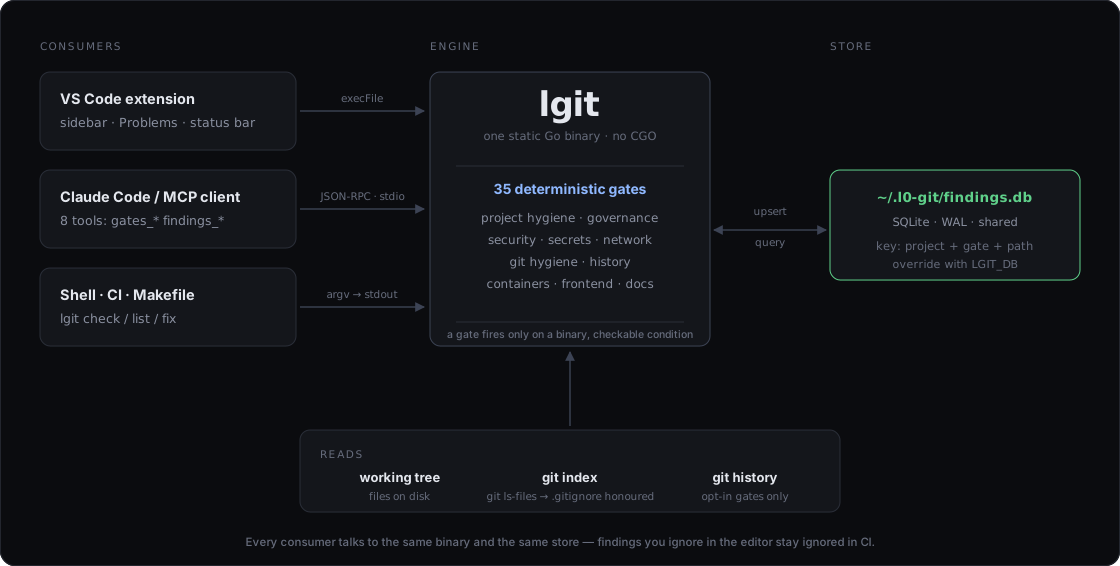
- The engine:
lgit, a single binary holding all 36 gates and the findings store. - The CLI:
lgit check,list,fix, … Everything prints JSON, so it pipes intojqand into CI. - The MCP server:
lgit mcpover stdio, exposing eight tools so an agent can run gates and read remediations. - The VS Code extension: sidebar tree, Problems pane, status bar, and an overview dashboard.
They are not three products sharing a name. They are three front ends over one binary and one SQLite file, which is why a finding you ignore in the editor stays ignored when CI runs.
Findings have a life cycle
A finding is keyed by (project, gate_id, file_path). Re-running a gate does not append duplicates: it updates what is already there, and a violation that went away flips to resolved rather than vanishing. ignored is sticky: mark something once and later runs will not resurface it.
Several findings of one gate at the same location: three addresses on a line, two broken links: share that key, so they are stored as one finding that lists every one of them, at the highest severity among them. What you ignore is what you can see.
What next
- Getting started: install and first scan.
- Gate reference: all 36 gates.
- Configuration:
.l0git.json, severities, scan options.